
At the time of me writing this, the Powerball jackpot is $131 million. And at its peak, it was $2.04 billion. That’s right, billions with a b.
Growing up, my dad bought a Powerball ticket every night and every purchase came with grand promises of how it would solve all our problems. At that time, I didn’t understand why someone would spend hard-earned money, especially when money was already scarce, on odds that were never in our favor. While I fortunately never picked up the habit, that question made me curious about the why.
My family immigrated from Vietnam, and my parents speak little to no English. In researching this, I came across something I haven’t been able to stop thinking about: unlike work, school, and almost every institution an immigrant has to navigate, gambling requires no English.
A casino floor is one of the few places in America where my parents’ generation wasn’t at a disadvantage. Casinos have long targeted Asian immigrant communities with culturally specific marketing and transportation. In Southern California, casinos have run buses from heavily Asian communities in the San Gabriel Valley, sometimes offering free lunches and gambling coupons. In San Jose, where I grew up, the city now takes in roughly $30 million a year in tax revenue from two casinos, M8trix and Bay 101, both less than 10 minutes from my childhood home (Source: San Jose Spotlight).
The gambling industry figured out how to provide in-culture, door-to-door access to a community in ways the American health system often hasn’t (more on this in another post). Nobody was running a free bus to a therapist. Crazy, right?
Nobody is being crazy
Morgan Housel opens The Psychology of Money with a chapter called “No One’s Crazy.” His central point is that financial decisions only look irrational when you lack the understanding of the circumstances that drive the thinking — The why. (Unrelated note: I avoid em dashes now since it’s an indicator that something was written by AI, but this one earned its place).
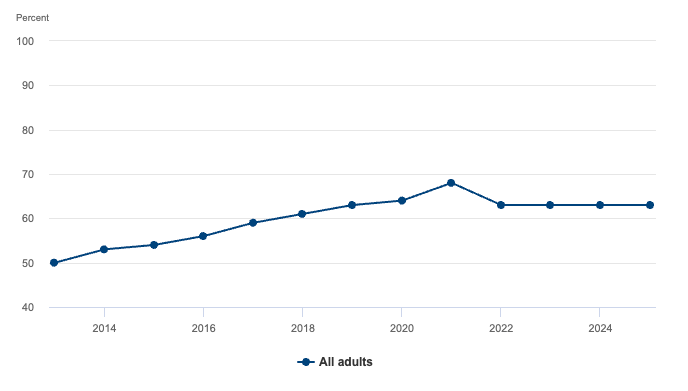
37% of Americans say they couldn’t cover a $400 emergency (Source: Federal Reserve), while lower-income households disproportionately spend hundreds of dollars a year on lottery tickets. From the outside, that math is objectively illogical: burning a scarce safety net on odds of one in millions.
But what looks irrational when you already have options can look very different when you don’t. If wages are flat, saving isn’t plausible, and the vacation, down payment, or college fund all feel so out of reach, a lottery ticket can become the only moment when the “good life” feels possible. You’re not buying odds. You’re buying the dream, at the only price point available to you.
That’s what I think I was missing as a kid. I thought my dad was buying a lottery ticket when he was actually buying a possibility. My dad would tell me of all the things he’d buy if he won: a house, a car, things for me (that I really didn’t care for or need, but I digress). Things that, at the time, felt completely impossible. The ticket gave us a few minutes where the impossible felt possible. That imagination is part of the product (completely unrelated but is this what Disney is doing too?)
Hope has a price
This is where I think the phrase “tax on hope” comes from. Gambling isn’t literally a tax. Nobody is forcing you to buy the ticket. But when the alternatives feel inaccessible, hope starts to have a price.
The person with a healthy emergency fund and fully funded 401k can look at a lottery ticket and see a bad return on investment. Whereas, the person who cannot imagine ever having either may see something else: for a few dollars, they get to imagine a different life where they had that, and more.
I know it doesn’t make the bet financially rational, but it makes it emotionally understandable. And understanding why someone makes a decision isn’t the same as saying it was a good one. Because money isn’t just math. It’s emotional and psychological, too. It’s why people panic-sell during a downturn or FOMO-buy when everyone else seems to be getting rich (but more on that in a separate post).
Growing up, I interpreted what I was seeing as a failure of discipline. I was wrong. Put together displacement, a language barrier, limited economic options, and an industry that knows how to meet people where they are, and you don’t necessarily get a story about “weak” character. You get a story about incentives. You get a story about scarcity. You get a story about an industry that has learned exactly what its customers are looking for and made a business out of it. Predatory.
That is a harder thing to say about your own family, and community at large, than that they should have “known better”. It is also, I think, the truer thing.
The path forward
That said, regulation alone can’t solve the thing gambling is filling. You cannot tell someone to stop buying hope without giving them something else to hope for.
That means making saving possible, making financial mobility feel real, making healthcare and mental health services accessible in the languages people actually speak, and building institutions that understand immigrant communities before a gambling company figures it out first. (I have so so so many thoughts on this as a whole, but i’ll save it for another day/post).
Because the problem was never just that my dad bought the ticket. The more interesting question is why the ticket could make promises that the rest of his life couldn’t.
The house always wins. The open question is who we keep letting it play against. Idk, but I won’t stop til I figure it out.


Leave a comment